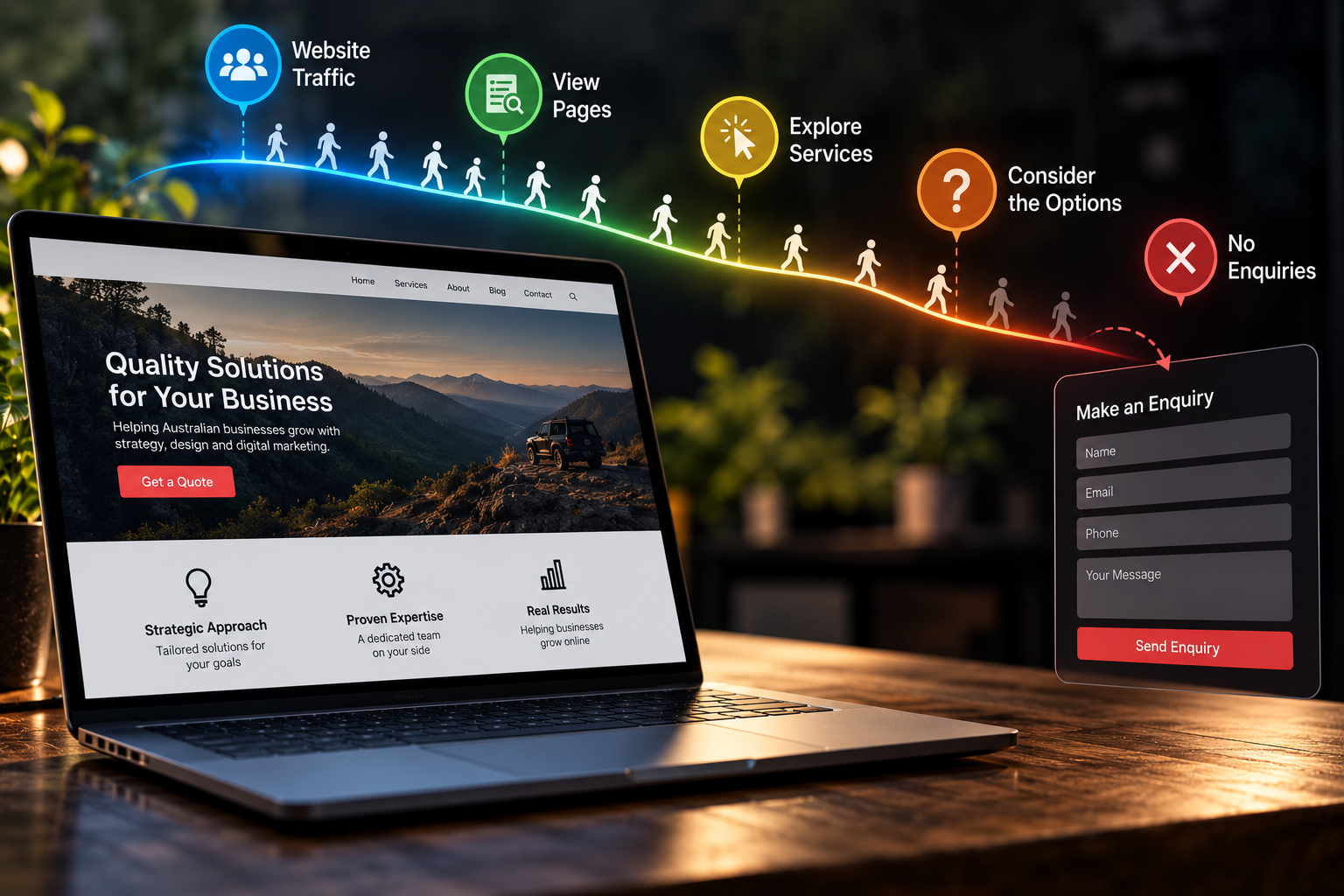
Getting people to your website is only half the job.
You can invest in SEO, paid advertising, social media and content marketing, watch your visitor numbers increase and still wonder why the phone isn’t ringing and your enquiry form remains quiet.
When that happens, the immediate reaction is often to assume you need more traffic.
Sometimes you do. But often, traffic isn’t the real problem.
The problem is what happens after someone arrives on your website.
Your website needs to quickly communicate what you do, who you help and why someone should take the next step. If visitors are confused, unconvinced or simply can’t find what they need, even a strong flow of traffic may produce very few enquiries.
Here are ten common conversion problems that can prevent website visitors from becoming customers, and what you can do about them.
1. Your Website Doesn’t Immediately Explain What You Do
Open your homepage and look at it from the perspective of someone who has never heard of your business.
Within a few seconds, can they understand:
- What you offer?
- Who it is for?
- What problem you solve?
- What they should do next?
If not, your homepage may be making visitors work too hard.
Businesses sometimes prioritise clever headlines over clarity. A statement such as “Transforming Tomorrow Through Innovation” might sound impressive, but it doesn’t necessarily tell a potential customer whether you design websites, repair cars, provide financial advice or sell software.
Your main message should give visitors immediate context.
That doesn’t mean your website needs to be boring. Strong website design combines clear communication with good visual presentation.
A visitor shouldn’t need to scroll through half the homepage to work out what your business actually does.
How to improve it
Start with a clear value proposition that communicates your main service and the benefit it provides.
Follow it with supporting copy and an obvious next step.
Clarity usually beats cleverness when someone is deciding whether to stay on a website.
2. You’re Attracting the Wrong Traffic
High traffic numbers can look encouraging in analytics, but not every visitor has the same commercial value.
Imagine two websites.
Website A receives 10,000 visitors each month but generates 10 qualified enquiries.
Website B receives 2,000 visitors but generates 40 qualified enquiries.
Website A has considerably more traffic, but Website B is doing a much better job of attracting and converting the right audience.
This is why traffic shouldn’t be viewed as an objective on its own.
Your SEO strategy should focus on search intent as well as search volume.
Someone searching:
“what is SEO?”
is probably at a very different stage from someone searching:
“SEO services for small business”
Both searches are relevant to SEO, but their likelihood of generating an enquiry may be very different.
The same principle applies to paid advertising. Campaigns can generate plenty of clicks while producing poor results if targeting, keywords, messaging or landing pages don’t align with the people most likely to become customers.
How to improve it
Look beyond total sessions and clicks.
Analyse which pages attract visitors, which search terms or campaigns bring them in, what those visitors do next and which traffic sources actually contribute to enquiries.
The objective isn’t simply more visitors.
It’s more of the right visitors.
3. Your Calls to Action Are Weak or Difficult to Find
You’ve explained your services and convinced someone that your business may be able to help.
What happens next?
If the visitor has to hunt around for a way to contact you, you’re creating unnecessary friction.
Calls to action should make the next step obvious.
Depending on your business, that might be:
Get a Quote
Request a Consultation
Book an Appointment
Enquire Now
Talk to Our Team
View Our Services
The right CTA depends on the page and the stage of the customer journey.
One common mistake is relying almost entirely on a Contact link hidden in the navigation.
Another is placing dozens of competing buttons on a page, giving visitors too many choices.
How to improve it
Give each important page a primary objective.
If the goal of a service page is to generate an enquiry, make that action visible at logical points throughout the page.
The CTA should feel like the natural next step rather than an interruption.
4. Your Service Pages Don’t Answer Enough Questions
A thin service page might contain a heading, a photograph, two paragraphs and a button.
That may technically describe the service, but it doesn’t necessarily give someone enough information to make a decision.
Before contacting a business, customers often want to understand:
- What exactly is included?
- Is this suitable for my situation?
- How does the process work?
- What makes this business different?
- How long does it take?
- What happens after I enquire?
- Are there examples of previous work?
- Are there any common limitations or requirements?
If the website doesn’t provide enough information, the visitor may return to Google and investigate another business.
Your service pages therefore need to do more than target keywords.
They need to help someone make a decision.
How to improve it
Review every major service page and ask whether it addresses the questions customers commonly ask before purchasing.
Use clear sections, descriptive headings, relevant imagery and FAQs where they genuinely add value.
Your online strategy should connect search intent with the information visitors need at each stage of their decision.
5. Your Website Doesn’t Build Enough Trust
Visitors don’t only ask themselves:
“Can this business provide the service I need?”
They also ask:
“Can I trust this business?”
Trust is particularly important when you’re asking someone to submit personal information, request a quote, make a significant purchase or engage you for an ongoing service.
A website can undermine trust in subtle ways.
Outdated content, broken links, poor-quality images, inconsistent branding, vague service descriptions and missing business information can all create uncertainty.
Trust signals can include
Customer reviews and testimonials.
Real examples of completed work.
Case studies.
Professional accreditations where relevant.
Clear information about the business.
Recognisable client or partner logos where you genuinely have permission to use them.
Transparent processes.
Secure browsing.
Professional visual presentation.
Useful, knowledgeable content.
Good graphic design also plays a role here. Consistent typography, imagery, colours and layouts make a business feel established and considered.
Trust isn’t created by adding a badge saying “Trusted”.
It comes from the overall experience.
6. Your Website Is Difficult to Use on Mobile
A website may look excellent on a large desktop monitor and still be frustrating on a phone.
Potential problems include buttons that are difficult to tap, text that’s too small, menus that are confusing, oversized images, intrusive pop-ups and forms that are painful to complete.
A visitor who has to pinch, zoom and repeatedly reposition the page is unlikely to have much patience.
Responsive design should therefore be considered from the beginning rather than treated as a final adjustment after the desktop site is finished.
How to improve it
Test important pages on actual mobile devices.
Pay particular attention to:
- Navigation
- Font size
- Button size
- Forms
- Image scaling
- Page speed
- Spacing
- Sticky elements
- Pop-ups
- Calls to action
Most importantly, test the complete conversion journey.
Can someone arrive from Google, understand your service, fill out the form and submit an enquiry comfortably from their phone?
If not, there is work to do.
7. Your Website Is Too Slow
Visitors don’t care why a website is slow.
They don’t know that your image is 8 MB, a plugin is making unnecessary database requests or several third-party scripts are loading before the page becomes usable.
They simply experience a slow website.
Large images, unnecessary scripts, excessive plugins, poor hosting and inefficient page construction can all affect performance.
Performance is also not purely a homepage issue. A fast homepage doesn’t help much if the service page receiving your Google Ads traffic is painfully slow.
Ongoing website maintenance should therefore include performance checks alongside software updates, security and general site health.
How to improve it
Review:
- Image sizes and formats
- Hosting performance
- Caching
- Plugin usage
- JavaScript and CSS
- Fonts
- Third-party tracking scripts
- Core Web Vitals
- Mobile performance
The objective isn’t to chase a perfect score for its own sake.
It’s to create a fast, stable experience for real visitors.
8. Your Enquiry Form Is Asking for Too Much
You’ve done the hard work.
Someone likes what they’ve seen and clicks Get a Quote.
Then they’re presented with fifteen required fields.
Job title.
Business size.
Full address.
Budget.
Preferred date.
How did you hear about us?
Detailed project description.
Phone number.
Company registration number.
Suddenly, contacting you feels like filling out an application.
Every additional required field creates another opportunity for someone to abandon the form.
That doesn’t mean every form should contain only a name and email address. Some businesses genuinely need more information to qualify an enquiry.
The important question is whether you need that information before the first conversation.
How to improve it
Ask only for information that is genuinely useful at the initial enquiry stage.
For many businesses, something similar to this may be enough:
Name
Business / Company
Website
Service required
Tell us about your project
You can gather additional information once the conversation begins.
9. Your Advertising and Landing Page Don’t Match
This is particularly important when you’re paying for traffic.
Imagine clicking an advertisement promising:
“Professional WordPress Website Design”
and arriving on a generic homepage that talks about SEO, social media, graphic design, strategy, advertising and six other services.
The visitor now has to find the information they expected to see.
That disconnect can reduce conversion performance.
Your paid advertising campaigns and landing pages should work together.
The message in the advertisement should continue naturally on the destination page.
If the ad promotes SEO, the landing page should immediately make it clear that the visitor has reached the right place.
If the ad promotes website design, the landing page should focus on website design.
How to improve it
Review the complete journey:
Search → Advertisement → Landing Page → CTA → Form → Thank You Page
Ask whether each step logically continues from the previous one.
This is also why campaign performance shouldn’t be judged only by click-through rate or cost per click.
A campaign generating cheap clicks but no qualified enquiries isn’t necessarily performing well.
10. You’re Not Properly Tracking Enquiries
Sometimes the website is generating conversions, but the business doesn’t have reliable measurement in place.
For example, someone might:
Visit through an advertisement.
Read a service page.
Return three days later through organic search.
Submit a contact form.
Which channel gets the credit?
Or perhaps your analytics platform records every visit to the contact page as a conversion even though the visitor never submitted the form.
That can make a campaign look much more successful than it really is.
Accurate conversion tracking is essential if you want to understand what is working.
What should you track?
Depending on your website and business, useful conversions might include:
- Successfully submitted enquiry forms
- Quote requests
- Appointment bookings
- Purchases
- Qualified phone calls
- Newsletter sign-ups
- Downloads where they have genuine business value
Micro-conversions such as button clicks can also be useful diagnostically, but they shouldn’t necessarily be treated as equal to an actual lead.
For example, clicking Get a Quote isn’t the same as successfully submitting the quote form.
That distinction matters when evaluating marketing performance.
Traffic Is Only One Part of the Customer Journey
Businesses often separate their digital activities into individual boxes.
SEO generates traffic.
Google Ads generates traffic.
Social media generates traffic.
The website sits there waiting for visitors.
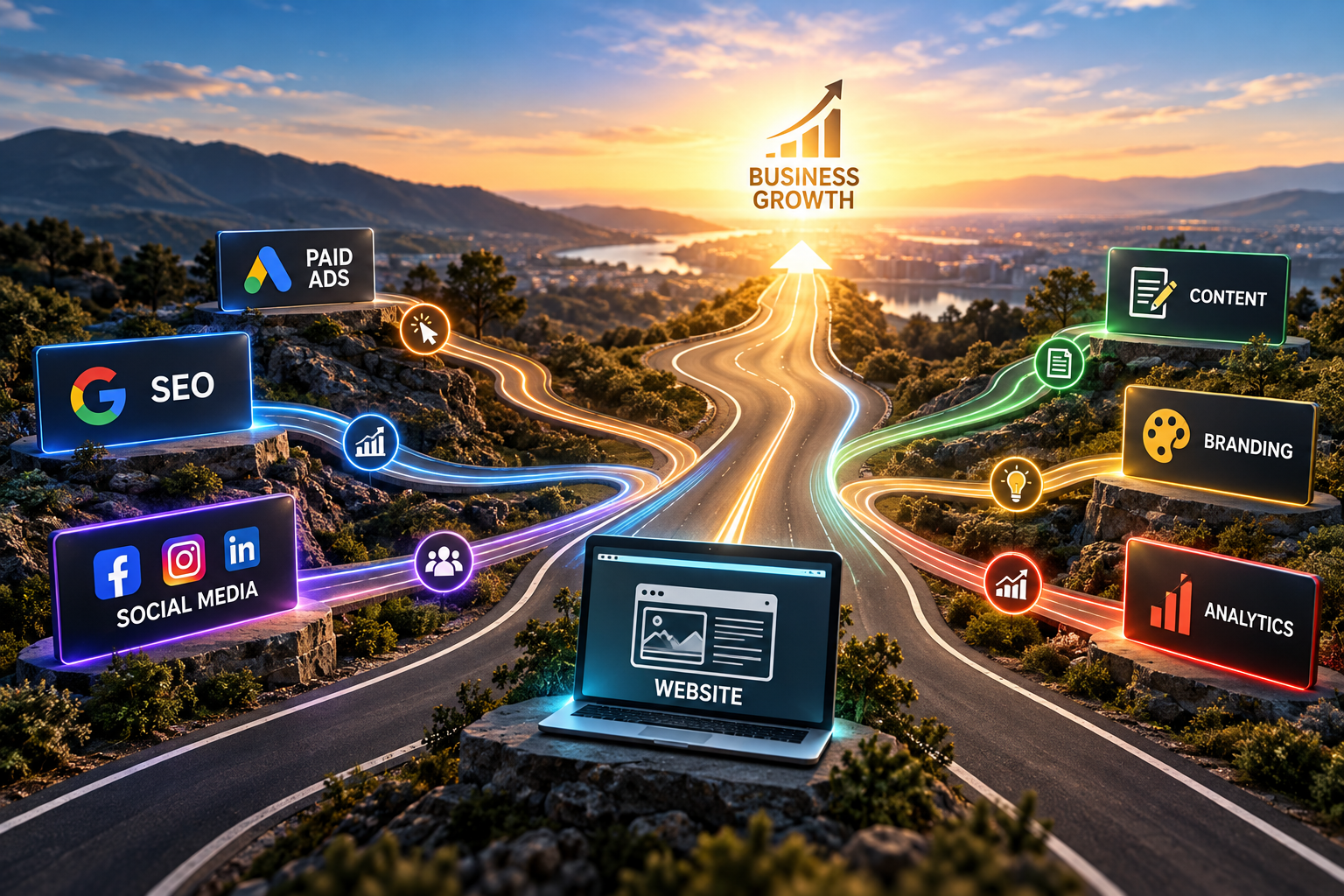
In reality, these elements need to work together.
Consider the complete journey:
Visibility → Click → Website Experience → Trust → Action → Enquiry
A weakness at any stage can affect the final result.
Excellent SEO can’t compensate for a confusing website.
A beautiful website can’t compensate for irrelevant advertising traffic.
A brilliant landing page can’t generate leads if the enquiry form doesn’t work.
And none of it can be properly improved if conversions aren’t being measured.
This is why we approach digital marketing as a connected system rather than a collection of unrelated tactics.
How to Work Out Where You’re Losing Potential Customers
If your website is receiving traffic but not generating enough enquiries, don’t immediately redesign everything.
Start with the data.
Look at your most important landing pages and examine what visitors actually do after arriving.
Ask:
Where is the traffic coming from?
If most visitors are arriving through irrelevant searches or poorly targeted campaigns, your acquisition strategy may be the problem.
Which pages are they landing on?
Your homepage may not be the most important page. A service page or blog article could be receiving significantly more entry traffic.
Are visitors engaging with the page?
Look at engagement alongside scroll behaviour, navigation and conversion actions where your analytics setup allows it.
Are people reaching the enquiry form?
If people regularly reach the contact page but don’t submit the form, investigate the form itself.
Are conversions being recorded correctly?
Test every important action yourself.
Submit the form. Check the thank-you page. Verify the email arrives. Test it on mobile. Check that your analytics and advertising platforms record the correct event.
Don’t assume tracking works simply because it was configured months ago.
More Traffic Isn’t Always the Answer
Suppose your website receives 2,000 relevant visitors each month and generates 20 enquiries.
If you double traffic without improving the website, you might expect roughly 40 enquiries, assuming everything else remains equal.
But what if instead you improve the experience and increase the proportion of relevant visitors who enquire?
You may be able to generate substantially more opportunities from the traffic you’re already paying or working to acquire.
That’s why conversion optimisation deserves attention alongside SEO, paid advertising and social media.
Before increasing your marketing budget, ask whether your existing website is making the most of the visitors you already have.
Your Website Should Have a Job
A business website isn’t simply an online brochure.
Every important page should have a purpose.
A blog article might educate and lead someone towards a related service.
A service page might explain an offering and encourage an enquiry.
A case study might demonstrate capability and build trust.
An About page might reassure a potential customer that they’re dealing with the right people.
A Contact page should make starting a conversation straightforward.
When these pages work together, the website becomes part of your sales and marketing process rather than simply somewhere you send traffic.
Turning Website Visitors Into Business Opportunities
If your website is getting traffic but not generating enough enquiries, don’t assume the solution is simply to attract more people.
Look at what those visitors experience.
Is your message immediately clear?
Are you attracting the right audience?
Can people quickly find the information they need?
Do your service pages answer their questions?
Does the website feel trustworthy?
Does it work properly on mobile?
Is it fast?
Is contacting you easy?
Do your advertising messages match your landing pages?
And are you accurately measuring what happens?
Fixing these issues can make your existing SEO, advertising and content efforts significantly more valuable.
At Big Boot Media, we bring together website design, SEO, paid advertising, social media, creative and digital strategy so the different parts of your online presence support the same objective: helping the right people find your business and giving them a clear reason to take the next step.
If you’re getting website traffic but aren’t seeing enough enquiries, get a quote and tell us what isn’t working. We can help identify where potential customers are dropping out of the journey and where the strongest opportunities for improvement may be.
Frequently Asked Questions
Why is my website getting traffic but no leads?
There can be several reasons, including irrelevant traffic, unclear messaging, weak calls to action, poor mobile usability, slow page speeds, insufficient trust signals or an overly complicated enquiry process. Start by identifying where visitors come from and what they do after reaching your website.
What is a good website conversion rate?
There isn’t one conversion rate that applies to every website. Results vary significantly according to industry, traffic source, service, price, audience and what counts as a conversion. Rather than relying solely on generic benchmarks, establish your current performance and work on improving it while maintaining lead quality.
Can SEO increase website enquiries?
SEO can help your business attract people searching for relevant products, services and information, but rankings and traffic alone don’t guarantee enquiries. Your website still needs to communicate effectively and provide a straightforward path towards conversion.
Should I redesign my website if it isn’t generating leads?
Not necessarily. A complete redesign may be appropriate if there are widespread usability, technical, branding or structural problems. In other cases, improving individual landing pages, calls to action, forms, messaging or page speed may be enough. Review the evidence before deciding.
How can I tell which marketing channel generates enquiries?
Set up accurate conversion tracking using appropriate analytics and advertising tools. Track meaningful actions such as completed forms, bookings and purchases rather than relying only on page views or button clicks. Attribution isn’t always perfect, so consider the wider customer journey when evaluating performance.
Should I send Google Ads traffic to my homepage?
Not automatically. A dedicated service or landing page is often more relevant when an advertisement promotes a specific service. The landing page should closely match the intent and message of the advertisement and provide an obvious next step.